


Hate to read? No problem. We can read the text to you.
This feature is available completely free. While we will be keeping an eye on how feasible it is to eat the costs associated, we hope to keep it that way.
Just click "Listen with Drawabox"!

Hate to read? No problem. We can read the text to you.
This feature is available completely free. While we will be keeping an eye on how feasible it is to eat the costs associated, we hope to keep it that way.
Just click "Listen with Drawabox"!

We've explored what this course is about, what it teaches, and how to get the most out of it. Now it's time to talk about one last major topic: tools.
This video, and the content below, explores what kinds of tools we use throughout the course - and more importantly, why.
)
This is probably one of the most contentious questions we get, as many of our students aspire to become digital artists. That's a goal I can certainly relate to - I myself have done all of my professional work digitally, and I even spent about ten years using digital tools to learn (between ages 13 to 23). I love working digitally.
Here's the thing - digital tools, and computers in general, exist for a singular goal: to make you faster and more efficient. Whether it's to write essays for school, pay your taxes, calculating the six hundredth decimal of pi, or creating an illustration, digital tools will allow you to complete your task more quickly. In the context of producing work for a client or employer, this translates to more money. The less time we spend, the more work we can get done, and thus the more value we can offer and the more we can be paid in return.
For that very same reason, I have found both in my own experience and in teaching other students, that digital tools have the opposite effect when we're learning. Learning is not about being fast. Learning is about taking our time, and both analyzing and understanding the motivation and reasoning behind the actions we take. It demands that time be invested, and while there are certainly things we can do to spend that time more effectively, tools that are designed to make you go faster will, by that same design, be more likely to cause you to rush, and to spend that time far less effectively.
Of course it's possible to learn using digital tools, but it's more of an uphill climb. While you may make a point of forcing yourself to take your time, there will always be those moments where you lose focus and slip back into following the nature of the tool.
Ink on the other hand - specifically the fineliner pens we use here - has a number of very useful qualities:
It makes it much harder to draw loosely and thoughtlessly. Every action you take is plainly visible with a dark stroke on the page. This forces us to slow down and consider what we're doing before putting those marks down. We can certainly still rush, but it very quickly becomes an unsustainable approach, forcing students to correct that behaviour.
It skips over a lot of the little hiccups we can run into when dealing with electronic hardware and software. A tablet needs to translate the physical action you're performing when drawing into signals that then tell the software what to display. There are countless things that can get in the way and cause both the hardware and software to behave incorrectly - bugs, driver conflicts, the specifications of your computer, and so on. All of this can be overcome, but it can be very frustrating for a beginner to navigate.
Depending on the tool you use, you may have different ways in which you can vary the marks you make. Some tools vary in different ways - drawing more heavily or lightly to make darker or fainter marks on the page, changing the angle of the stroke to create broader or narrower marks, and so on. The pens we employ here - which I'll expand upon a little further down the page - really only vary in one way: the thickness of the stroke. Applying less or more pressure will create a thinner or thicker stroke, while that stroke will continue to remain rich and dark (assuming it's not running dry, anyway). This helps us train our pressure control more naturally, which itself is a very useful skill to learn if you plan on working digitally later on.
)
So! Here's our daily driver - the 0.5mm fineliner. They produce a dark, rich stroke, and allow a fair bit of variation in width by varying pressure - although they can be a bit fragile, so avoid pressing too hard on them, as this can damage the tip and impede ink flow.
There are many different brands of fineliners out there, covering a wide range of prices and qualities. For the purposes of Drawabox you do not need to get something expensive, although it is worth considering that the cheaper pens are generally more fragile, and have ink that won't last quite as long. This can still be an advantage if you're still getting the hang of controlling your pressure (if you're prone to damaging them, better to have pens that aren't going to last that long anyway, but also won't cost you a ton).
While the 0.5mm size is ideal, you'll be okay with anything within the 0.4-0.6mm range. Also, different brands will have nibs that are either more firm or more flexible, so there are some discrepancies, with a more flexible 0.4mm tip actually making thicker marks, and a 0.6mm stiffer tip producing thinner marks.
A lot of brands will sell their pens in multi-size packs for cheaper, but I recommend avoiding these if you can, unless you plan on using the other sizes in other projects. If possible, try to get packs that contain multiple pens of the same size. A lot of art supply stores also sell their pens individually, and even allow you to test them out - something that is especially advantageous when you're going to an actual store, because duds - that is, pens that have dried ink, or for whatever reason don't work right - are definitely a problem when it comes to buying pens.
Here's a rundown of some common brands, although there are a lot out there. You'll also find a review of many different brands on this playlist from ScyllaStew's YouTube channel - she spent half of the 250 Box Challenge testing out different pens for each page, and reviewing how they performed.
Sharpie. Sharpie makes pens that are fairly widely available and quite cheap. The two of theirs that are suitable for Drawabox are the Sharpie Ultrafines and the Sharpie Pens. The Sharpie Ultrafines are a bit thicker, and the Sharpie Pens are a bit thinner, but they're some of the cheapest pens you'll find. Sharpie also produces a set of coloured pens that can be useful in the exercises where we analyze our work.
Sakura. Their Pigma Micron's 08 size fineliners are commonly used. While not the cheapest, they are on the lower end of the price spectrum. Their Pigma Micron PN pens are technically not fineliners, but they'll also work for our purposes here.
Staedtler. These are on the pricier end, but they're also the pens I generally gravitated to when learning. In my experience, their Staedtler Pigment Liners are quite resilient and last a good while.
Faber Castell. Their PITT Artist Pens are generally quite high quality, with archival india ink - but they are quite expensive as a result. I find it hard to recommend these - they're great pens, but for Drawabox, they offer a lot of things we don't really need to worry about. If you do get these, be sure to pick up their "F" size.
)
If you're uncertain about whether or not a pen is a fineliner, take a close look at the actual tip of the pen. It should look like this, with a metal tube tipped with a little bit of plastic, which absorbs the ink and applies to the page.
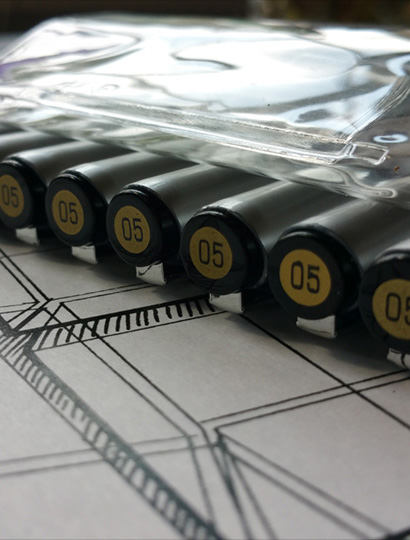
There are a lot of challenges when it comes to finding pens - they're expensive, they come in those annoying packs with different sizes, and as I mentioned above, sometimes you get pens that don't work right. In the last few years, we've been importing and selling pens ourselves in an attempt to address this problem.
You can find them here. We sell them in packs of 10 for $17.50, with free shipping in the continental United States. We also hand-test them on the back of a Drawabox sticker before shipping them out, and include that sticker with the pack, so as to bring down the chance that you'll get a dud.
Every tool has its strengths and its weaknesses, making it better in some cases and worse in others.
Why not pencil?
Pencil allows students to sketch very lightly on the page, effectively combining the "thinking" and "doing" into one step. For the specific concepts Drawabox teaches, this isn't ideal. Instead, we want to focus on tools that force students to think first, then act. There are plenty of other teaching methodologies, and even topics that benefit from this aspect of pencils, so they're by no means a bad tool - just not a good fit for what we do here.
What about ballpoint?
Ballpoint is like the pencils of the pen world - but they're not all bad, and we actually do use them later in the course, for Lesson 6 onward, where students have had ample opportunity to learn to think before they act, but where the permanence of ink is still important. Those later lessons get very complex, to the point that the heavy weight of fineliners becomes just a little too burdensome, so we actually encourage switching to ballpoint pens at that point. We also allow students to use ballpoint pens through Lesson 1 and the 250 Box Challenge, but we'd still prefer that they use fineliners. The expectation is that if you're using a ballpoint in Lesson 1, that you're working at getting your hands on some proper fineliners.
Technical pens?
Here's where it can get kind of confusing. Depending on where you live, technical pens may be another word for "fineliner", but they can also refer to a similar type of pen that has a full metal nib. The latter kind is designed to produce a stroke of a highly consistent thickness, whereas fineliners have more give in their tips, allowing them to produce a more variable line thickness. This line weight variation is what we want, so traditional technical pens that only produce a very consistent line weight would not be appropriate for this course.
Fountain pens? Dip pens?
The main issue here is that these kinds of pens have a much steeper learning curve, compared to fineliners. Also, not all fountain pens and dip pens are the same - some nibs are designed to create consistent lines, others will flex more to provide variable stroke widths. While you can definitely find pens of this sort that will mimic the behaviour of fineliners, the risk is that students sometimes happen upon them in their parents' old abandoned writing tools, but not actually have prior experience in their use. In trying to use them for this course, that would introduce a pretty significant additional challenge which would serve as a distraction.
And gel pens?
Gel pens are a type of ballpoint pen that have a much richer, darker, more consistent ink. Like ballpoint pens, they're allowed for Lesson 1 and the 250 Box Challenge, but with the expectation that you're still working to get fineliners. The main difference between gel pens and fineliners is that the fineliners allow for more variation based on pressure.
Keep in mind - we are not using pens because I'm trying to teach you how to work with ink. Ink is a complex medium of its own, and one I honestly know very little about. What we're learning here, as discussed earlier in this lesson, is very limited. To draw marks with confidence, and to understand how the things we draw exist in 3D space, rather than just as lines on a flat page.
That means that you're still going to want to learn, either through courses or targeted practice, about whatever other tools you plan on using. Just as digital tools require you to learn the ins-and-outs of each piece of software and hardware, any other traditional medium will require the same.
Here are a few from our sponsor, New Masters Academy, that might be of interest:
This one's really a big overview of many different traditional tools and mediums - from graphite, to charcoal, to markers and more.
Even though Drawabox has you use ink, that doesn't mean we teach you much about its use. Miles Yoshida demonstrates the wide variety of tools that fall under the "ink" category (as well as some that can be used wonderfully alongside it), and will introduce you to a whole new world of creativity.
Personally, as I am strictly a digital artist myself, Adobe Photoshop is my tool of choice. It's not the only tool out there (with Clip Studio, Krita, and others gaining steam), but it's still holding firm to the title of "industry standard". In this course, Chris Legaspi explores every corner of Photoshop, from sketching and painting from scratch, to retouching photos, and more.
Sign up to New Masters Academy with the coupon code DRAWABOX22 — you'll get a full 25% off your first billing cycle.
All I ask is that you don't draw on lined paper... or like, napkins. In fact, above all else, I highly recommend using regular printer paper. It's a great size (A4, 8.5"x11") and will allow plenty of room to think through spatial problems (as you get smaller and more cramped, this can become a problem), it's not going to fold back over while you're drawing like a sketchbook might, and it's not going to leave you feeling afraid of ruining a sketchbook.
If you insist on using something fancier, try not to go too small, and if it's a sketchbook, ringed is better as it lets you fold the pages back and get them out of the way. But really - there's no good reason for you to use anything other than printer paper. If you want to produce a 'record' of your progress and growth, you can always collect those pages, then take them to a print shop later to produce them into a physical book of some sort. It's not a desire that should be changing how you work through this material, however.
Also, another thing to keep in mind is that you should not be using ink on paper made for graphite or charcoal. Paper more similar to printer paper (which, again, is the ideal choice for these exercises) is great, but anything rougher and with more tooth to it will drain your pens' ink more quickly.
)
Certain lessons and exercises will require other tools as well, ranging from simple rulers (generally you can use any sort of straight edge) to ellipse guides and french curves in lessons 6 and 7.
Ellipse guides/templates come in sets and can get expensive, but you can usually shop around online and find them for cheaper on places like eBay. They are extremely useful, however I wouldn't recommend buying them until you've actually reached those lessons. Once you do, they are a sound investment.
There are also "master ellipse templates" which are essentially a single ellipse guide featuring ellipses of several different degrees, but limited to a few smaller sizes. These are generally adequate for Lessons 6 and 7, and are way cheaper. You'll find one listed in the recommendations page.
If you're planning on going to the store (or hopping onto the internet to do some online shopping) specifically for supplies to jump into this course, here's a quick list of things you'll want to pick up. Some are required, others can be improvised with other things you'll probably have at home. You can think of this as a summary of what's explained above.
0.5mm Fineliners, highly recommended, and required if you're submitting for official (paid) critique. If you for whatever reason can't get your hands on them immediately, don't worry - you have time. You can use a ballpoint pen for Lesson 1 and the 250 Box Challenge, but it is best that you use a fineliner as soon as you can, and that you have one before starting Lesson 2. If you can't find a 0.5mm specifically, try and stay within the range of 0.4-0.6.
A4 (8.5"x11") Printer Paper, highly recommended. This really is the best option for paper. Do not use sketch paper or other paper intended for dry media. It will drain your pens and hinder you as you draw.
Ruler. Any straight edge will do, but you'll want something the length of your page that allows you to draw precise, straight lines for the parts of exercises that require it.
Coloured Pens. This isn't necessary, and when they come up in the lessons all that matters is that you've got something to draw with that is easily distinguishable from your main fineliner/pen. It's primarily for the purposes of analyzing our work after the fact so we can identify where we need to focus our efforts as we continue forwards.
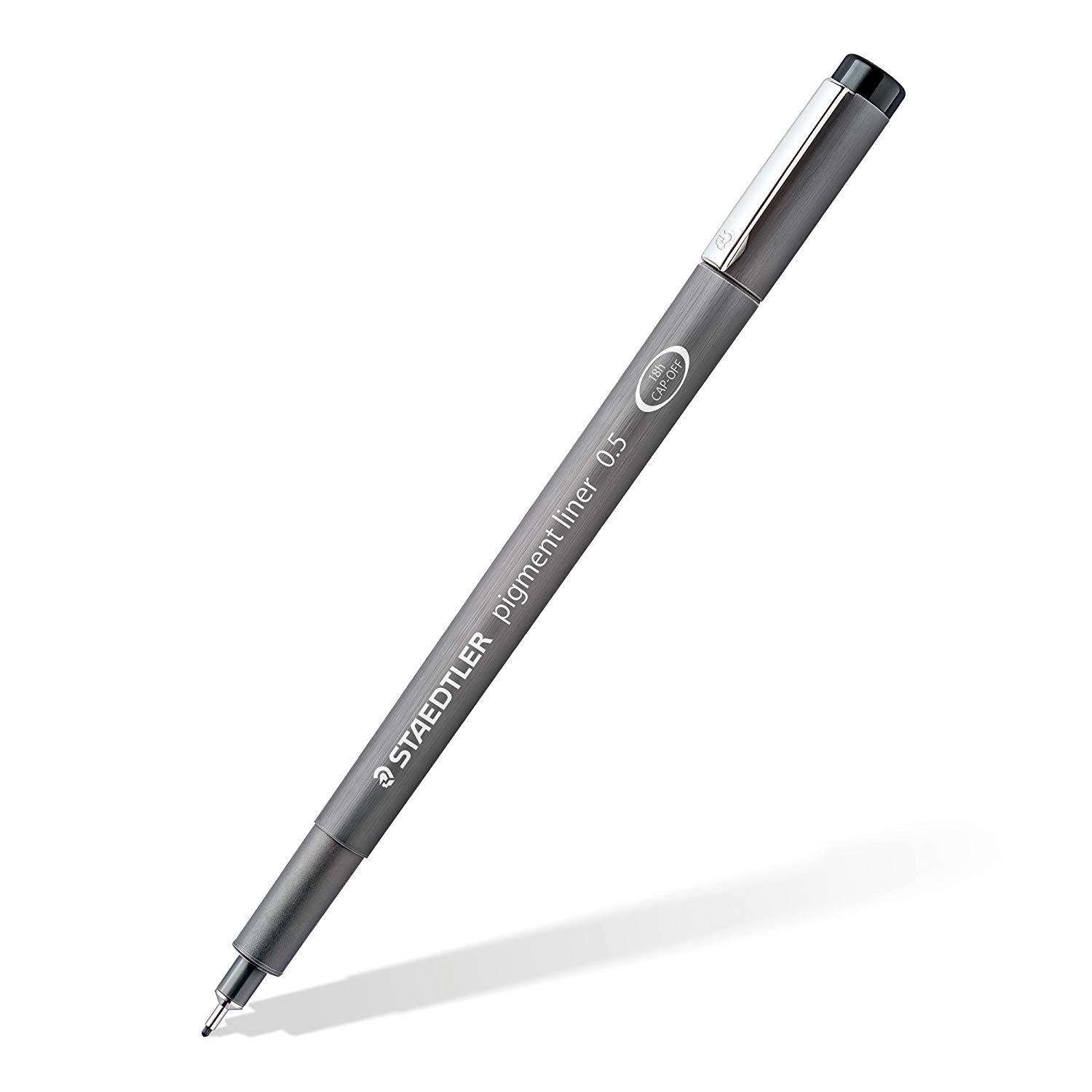
These are what I use when doing these exercises. They usually run somewhere in the middle of the price/quality range, and are often sold in sets of different line weights - remember that for the Drawabox lessons, we only really use the 0.5s, so try and find sets that sell only one size.
Alternatively, if at all possible, going to an art supply store and buying the pens in person is often better because they'll generally sell them individually and allow you to test them out before you buy (to weed out any duds).


Having your work reviewed by others is critical, as those who are just starting out aren't in a position to properly judge their own work, and won't be for quite some time. Don't be afraid to show your struggles - it's by analyzing your mistakes that we can help you grow. Perfect homework is not what we're looking for; we just need it to be complete.
There are currently two places you can get your work critiqued by the community - Reddit and our Discord Chat Server.
Both of these are completely free.

If you are interested in receiving extra help, I critique the work of those who support Drawabox on Patreon.
All of these private critiques are done through reddit, in specific threads where students post their work as a comment, including a link to their work (often hosted on Imgur, though most image hosts are okay).
My requirements are more strict than the free community critiques:
The minimum pledge for this lesson is $0.00/month. The orange button above will take you to the reddit thread for this lesson, you can post a link to your work there and I'll be notified. Once I catch the submission, I'll add it to this backlog spreadsheet.
Pledges are collected at the beginning of the following month, but you may start submitting your work immediately. If you're a new patron, I'll be reaching out to your shortly to collect your reddit username.
This website uses cookies. You can read more about what we do with them, read our privacy policy.


